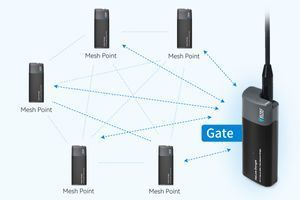
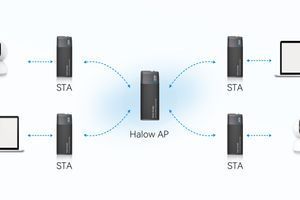
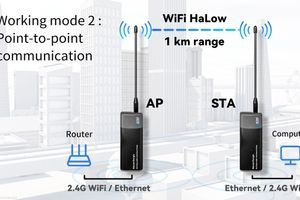
The world of the Internet of Things (IoT) is expanding at an incredible pace. From smart homes and cities to industrial automation and agriculture, we are connecting more devices than ever before. However, traditional Wi-Fi, while perfect for high-speed internet access, often falls short when it comes to the unique demands of IoT: long range, low power consumption, and massive device capacity.Enter Wi-Fi HaLow™ (standardized as IEEE 802.11ah), a technology designed specifically to overcome these challenges and unlock the true potential of a connected world.
What Exactly is Wi-Fi HaLow?
Wi-Fi HaLow is a new Wi-Fi standard that operates in the sub-1 GHz frequency band (typically around 900 MHz), unlike traditional Wi-Fi which uses the crowded 2.4 GHz and 5 GHz bands. This fundamental difference gives HaLow its "superpowers." Lower frequency radio waves can travel much farther and penetrate through walls, floors, and other obstacles with significantly less signal loss.Think of it as Wi-Fi, but optimized for range and battery life instead of raw speed.
Key Advantages of Wi-Fi HaLow
- Unprecedented Range: While a typical Wi-Fi router covers a few dozen meters, a single Wi-Fi HaLow access point can cover a radius of over 1 kilometer. This makes it ideal for large properties, agricultural fields, and sprawling industrial sites.
- Extremely Low Power Consumption: HaLow was built from the ground up for efficiency. Devices using this technology can operate for months, or even years, on a single small battery. This is a game-changer for remote sensors and other "set-and-forget" IoT applications.
- Superior Penetration: The sub-gigahertz signal easily passes through concrete, brick, and other materials that often block or weaken 2.4/5 GHz signals. This ensures a more reliable connection for devices located in basements, deep within buildings, or outdoors.
- Massive Device Capacity: A single HaLow access point can support thousands of connected devices (over 8,000), making it perfect for high-density environments like smart buildings or factory floors.
- Native IP Support & Robust Security: Because it's still part of the Wi-Fi family, HaLow offers native IP support, simplifying integration with existing networks and the cloud. It also incorporates the latest WPA3 security protocols, ensuring your data remains safe.
Wi-Fi HaLow vs. Other Technologies
| Feature | Wi-Fi HaLow (802.11ah) | Traditional Wi-Fi (802.11n/ac/ax) | LoRaWAN |
|---|---|---|---|
| Range | ~1 km+ | ~50-100 m | 2-15 km |
| Data Rate | 150 Kbps – 86 Mbps | 100 Mbps – 10 Gbps | 0.3 – 50 Kbps |
| Power | Very Low | High | Extremely Low |
| Capacity | Very High (8000+ devices) | Low (dozens of devices) | High |
| IP Support | Native | Native | No (via gateway) |
| Security | WPA3 | WPA3 | AES-128 |
As you can see, Wi-Fi HaLow fills a crucial gap. It offers significantly higher data rates than other LPWAN technologies like LoRaWAN, while providing much greater range and power efficiency than traditional Wi-Fi.
Common Applications for Wi-Fi HaLow
- Smart Agriculture: Monitoring soil moisture, temperature, and crop health across vast fields.
- Industrial IoT (IIoT): Connecting thousands of sensors in factories, warehouses, and processing plants.
- Smart Buildings: Managing HVAC, lighting, and security systems across entire commercial buildings.
- Logistics & Asset Tracking: Monitoring the location and condition of goods in large yards or warehouses.
- Smart City Infrastructure: Connecting traffic sensors, smart parking meters, and public lighting.
The Future is HaLow
Wi-Fi HaLow is not here to replace your home Wi-Fi; it's here to extend it. By providing a reliable, power-efficient, and long-range solution, it is set to become a cornerstone of the Internet of Things. Ready to explore the next generation of wireless connectivity? Check out our range of IoT modules and development boards at Halow and start building the future today.